Every crop protection guide gives some version of the same rule: watch the forecast, watch the threshold, spray before the window closes. It is sound advice and it is also, for a large share of the farmers reading it, advice built on an assumption that does not hold. The assumption is that the forecast reaches you with enough lead time to act on it. A study of 217 smallholder crop farmers in Elundini local municipality, Eastern Cape province found that access to short-term weather forecasts and seasonal forecasts is not evenly spread across a farming population. It depends on who owns a radio, who owns a phone, who reaches an extension officer, and who has the land size and income that make forecast information worth chasing in the first place. Crop protection decisions do not start at the threshold. They start at whether the information reached the farm at all, and that is the gap this piece is about.
Measured by NuaSense weather stations and soil probes on Kenyan farms, over the period stated with each figure. Past readings, not a forecast.
The rule assumes a forecast that already arrived
Spray-before-the-rain and scout-before-the-outbreak both assume a farmer already has the input the rule needs. The Eastern Cape study found that access to short-term forecasts rose with age, monthly income, radio ownership, timely climate information, and a farmer's own sense that climate change was hurting their crop. Access to seasonal forecasts, the longer view that would tell a farmer whether the coming season favours heavier disease pressure, rose with mobile phone ownership, contact with extension services, land size, and a farmer's grasp of climate change generally. Neither access pattern is about willingness. A farmer who wants the forecast and lacks a working phone, extension contact, or land size large enough to justify the outreach simply does not get it, however sound their intentions. The protection rule was written for someone standing inside that access. On a smaller block, without regular extension contact, the rule is not wrong. It is addressed to someone else.
Where the assumption was actually tested
It matters that this finding comes from Eastern Cape province in South Africa, not from Kenya. The survey covered 217 farmers in one municipality, and its access determinants, radio ownership, income, land size, extension contact, are plausible drivers everywhere but were only measured there. Kenya has its own extension geography and its own mobile penetration pattern, and no equivalent access survey sits in the material behind this piece. What transfers is the shape of the finding, not the numbers: forecast access is unevenly distributed by asset ownership and institutional contact, and a Kenyan grower has to work out where they sit on that distribution rather than assume the guide's timing advice was written with them in mind.
Education cut against seasonal forecast access, and land size cut both ways
Two results in the same study run against the intuition that more education or more land automatically means better information. Being educated negatively influenced access to seasonal forecasts in that sample. Land size had a negative and significant effect on short-term weather forecast access, even as it had a positive effect on seasonal forecast access in the same data. Read plainly, that means the largest and the smallest farmers in the sample were not accessing the same forecasts for the same reasons, and neither the school-educated nor the land-rich farmer can be assumed to be the well-informed one by default. This is worth sitting with because it cuts against a habit common in agricultural extension writing, which treats education and landholding as proxies for capacity to absorb information. The study does not explain why education correlated negatively with seasonal forecast access; it simply reports the direction. A plausible reading is that better-educated farmers in that sample relied on other information channels the survey did not measure, or that seasonal forecasts reach through informal, land-tied networks that formal education does not substitute for. A Kenyan grower with a diploma and a modest plot, or a large holding and little schooling, should not assume either credential puts them closer to the forecast. The honest response is to check which channels actually reach your own farm, phone, radio, cooperative, extension visit, rather than assume status confers access.
The size of the loss when the forecast never lands
The cost of missing a protection window shows up in the record as production loss, not as a spray decision logged and reviewed. Climate change has driven a measured 5 percent drop in agricultural productivity over the last three decades, cited by Mashizha (2019) via the Eastern Cape access study. More concretely, roughly 9,656 tons of maize were lost among smallholder farmers in Ghana during the 2015 El Nino drought, and about 76 percent of farmers surveyed in Zimbabwe agreed their maize output has been falling for two decades. In South Africa, roughly 60 percent of planted maize was destroyed by the 2022 floods. None of these figures describe a spray decision specifically. They describe what happens when a farming population absorbs a climate event without the forecast reach to prepare for it, and protection decisions, spray or otherwise, sit inside that same information gap.
What the projections say about the years ahead
The same body of research projects further declines rather than a plateau. Global maize yields are expected to fall by up to 10 percent by 2050 because of climate change, and the African decline is expected to exceed that global figure. Millet and sorghum outputs in Africa are projected to fall by 15 and 17 percent respectively by 2050. Across Sub-Saharan Africa, cassava, sorghum, millet, groundnut and maize yields are projected to fall somewhere between 8 and 22 percent by the end of the century, and South African maize output specifically is projected to fall by up to 38 percent by 2100. These are projections, not observations, and they say nothing about any single farm's coming season. What they do say is that the access gap described above is not closing on its own. If forecast reach was already uneven, a harder climate does not make the gap smaller.
Why a threshold needs a record behind it, and a record needs a signal
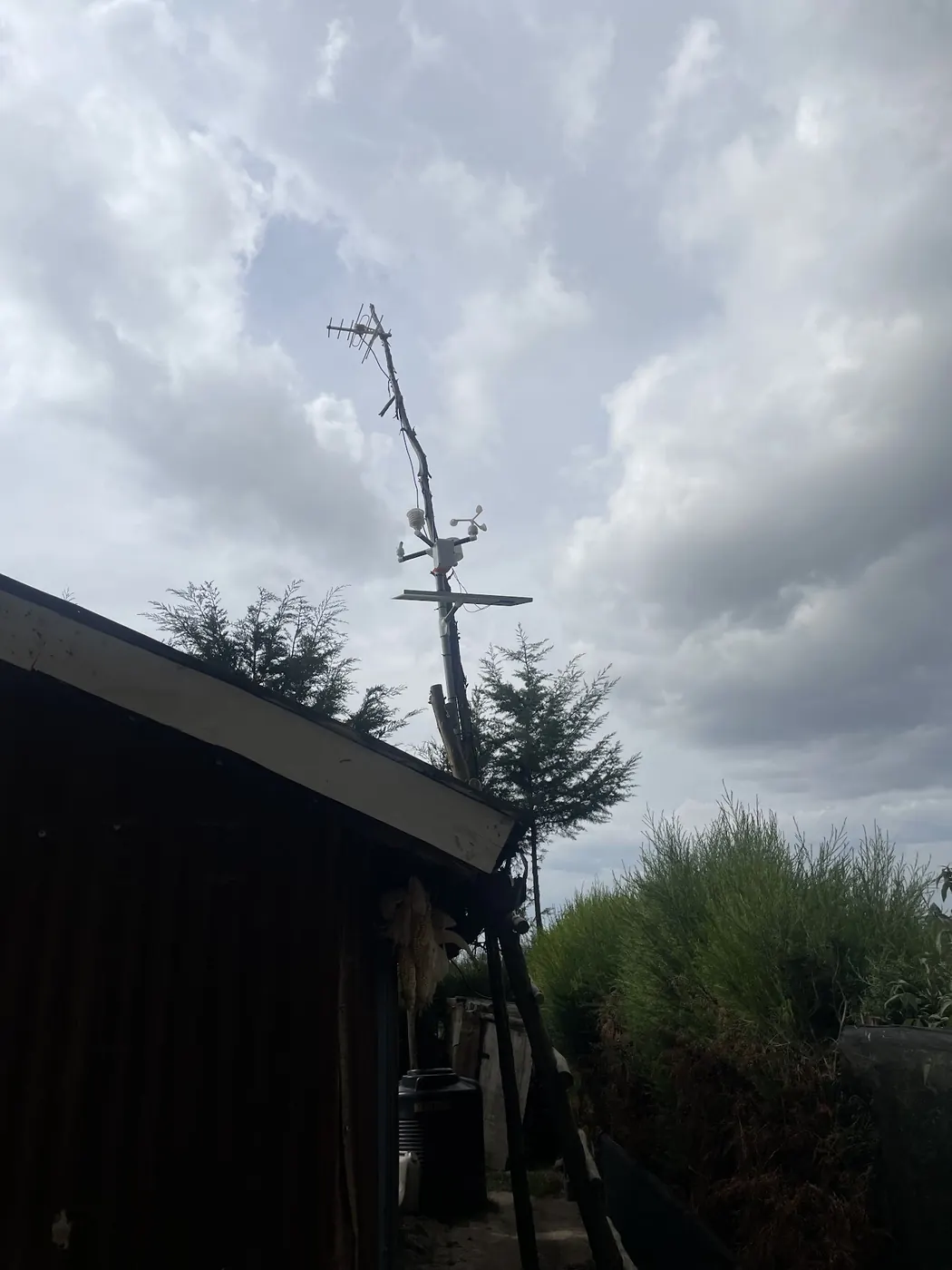
A protection threshold, spray now, hold off, is only as good as the record that feeds it. Without weather data or scouting notes behind a decision, a farmer is choosing between memory and guesswork under pressure, and both bend toward whichever outcome felt most recent. This is where a Kenyan grower with a weather station on the farm has something the Eastern Cape sample did not: an independent instrument record rather than a forecast someone else has to pass along. Our own station network recorded a spray window quality score, computed hourly from temperature, humidity and leaf wetness, that scored 60 or better in only 19 percent of station-hours across 5 stations over the period 07 August to 06 September 2026, with 52 percent scoring below 30. That kind of record does not predict tomorrow's window. It tells you, after the fact, how often a genuinely good spray window actually existed over the past month, which is a very different and more useful number than a memory of when it last felt right to spray.
Leaf wetness, and why a spray applied into standing moisture is wasted
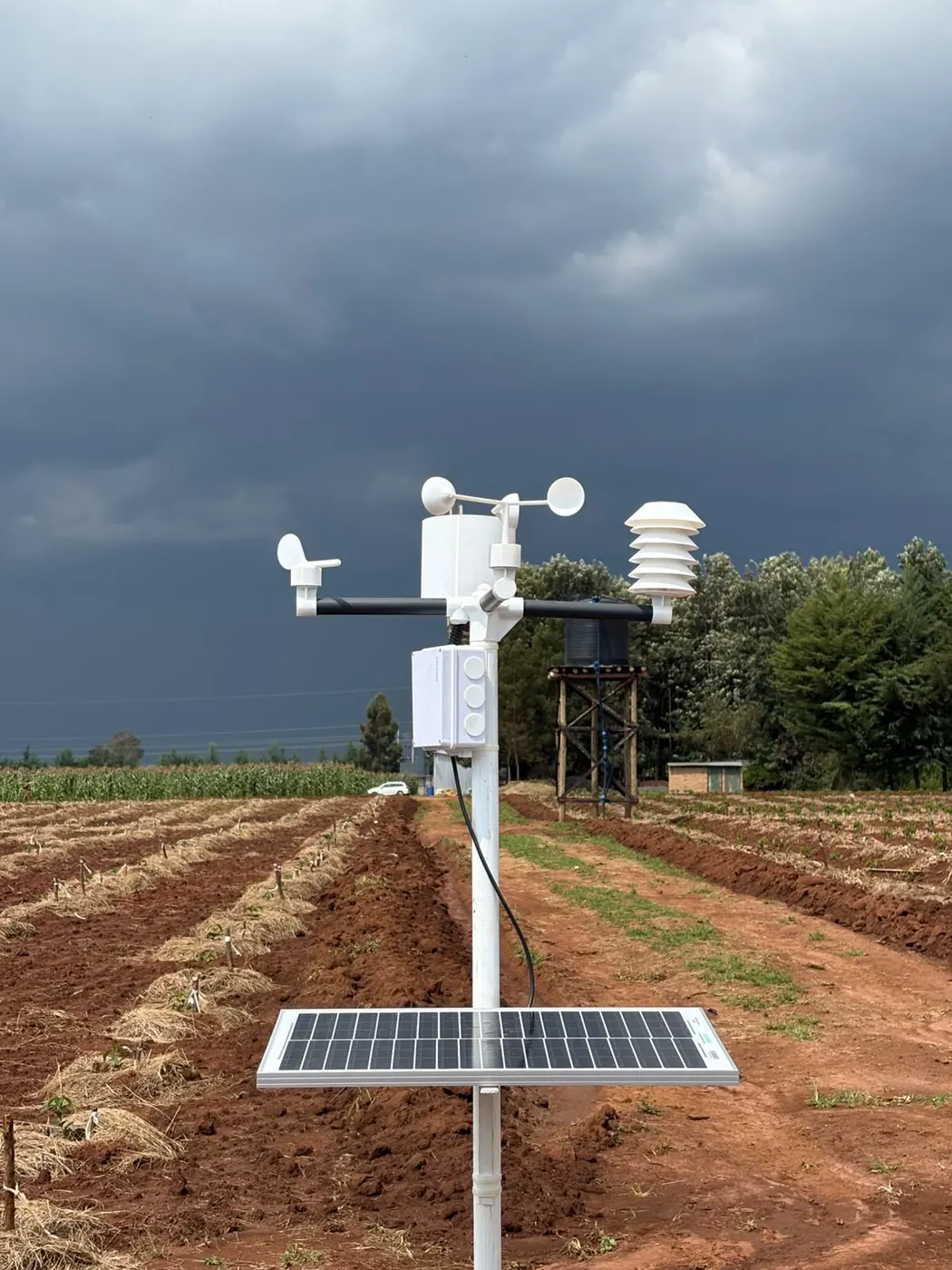
Leaf wetness duration matters to a protection decision because many fungal pathogens need a continuous wet period on the leaf surface to establish, and a spray applied while the leaf is already wet from dew or rain runs off, or gets diluted, before it can act. Across the same 5-station record, leaf-wet conditions were recorded in 26 percent of station-hours, which works out to roughly 6.2 hours in an average day. That is a substantial share of daylight and darkness combined sitting in conditions unfavourable to a fresh application. Vapour pressure deficit over the same period averaged 0.89 kPa and peaked at 3.32 kPa, a range wide enough that a single blanket rule for spray timing across a season would be wrong for large stretches of it. None of this replaces scouting for the pest or disease itself. It replaces guessing at atmospheric conditions with a logged one, and a logged record is the thing a farmer without forecast access can build for themselves, one uplink at a time, without waiting on a radio bulletin or an extension visit that may not come this month.
Soil moisture and soil temperature complicate the same decision from below
A protection decision is not only about what is happening in the air around the leaf. Soil conditions shape whether a crop under disease or pest pressure is also under water stress, which changes how it responds to any protectant applied. Across three NuaSense soil probes over the same period, soil moisture averaged 67 percent of sensor scale, with most readings between 18 and 90 percent, a spread wide enough that a single farm-wide moisture assumption would be wrong for parts of the block. Soil temperature at the same probes averaged 16.9 degrees Celsius, and the two probe depths moved differently across the period: the steadier depth shifted through 2.3 degrees while the more variable one shifted through 3.2 degrees, a factor of roughly 1.4. A crop already under moisture stress at one depth and not at the other is not going to respond to a protection application the way a textbook threshold assumes, because the textbook threshold was written for a crop under one set of conditions, not a block with two.
Rainfall variability makes any single-day rule fragile
Rainfall totals recorded across our own network ranged from 0.0 mm to 149.5 mm across 8 stations over the same one-month period, a spread between stations that were not co-located and were simply standing on different farms. That spread alone should discourage a farmer from assuming a neighbouring farm's spray timing applies to their own block. The longer record backs this up further: the CHIRPS satellite rainfall product puts average September rainfall at the locations where our stations stand at 35 mm across 43 years of record, with a driest September of 5 mm in 1997 and a wettest of 79 mm in 2020. A rule tuned to an average September would have been wrong in both of those years, in opposite directions. This is the same argument an earlier piece on this site made about rainfall data accuracy in the context of rice and water timing: an average conceals more than it reveals when the record behind it swings this widely.
Sustainable protection practice is a bundle, and bundles are hard to adopt piecemeal
European policy has set explicit targets to cut the risks associated with pesticide use, and the research behind those targets makes a point worth carrying into a Kenyan context even though the policy itself was not written for one. The Queen's University Belfast framework on sustainable crop protection argues that sustainable practices work as combinations of individual measures, rather than single swaps, and that current policy tools rarely capture this. It also argues that behavioural factors, how a farmer actually decides under pressure, are under-researched relative to how much they matter, and that adoption should be measured by outcomes such as pesticide risk reduction rather than by simple uptake counts. A Kenyan grower reading a protection guide that recommends one swap, a resistant variety, a delayed spray, a scouting routine, should treat it as one piece of a bundle rather than a complete fix, because the research behind the advice was built around bundles from the start.
What to actually track when the forecast is not coming
None of the material behind this piece gives a spray threshold in millimetres, degrees or pest counts, and this piece will not invent one. What it does give is a case for building your own record rather than waiting on someone else's forecast to reach you. If mobile phone ownership and extension contact are the two factors most associated with forecast access, per the Eastern Cape study, then a farm that cannot rely on either has to substitute an instrument record for the forecast it is not getting. That is a narrower claim than a threshold, and a more honest one. Our earlier piece on climate change and Kenyan crop yields covers how rising temperatures and shifting rainfall are already showing up in maize, tea and coffee yields, and the crop protection and pesticide optimisation pages on this site set out what a farm-level record can add once it exists. Building that record does not close the access gap the Eastern Cape study measured. It gives a farmer standing outside forecast reach something to act on instead of a guess. Also drawn on for this piece: the FAO Eastern Africa Subregional Strategic dialogue proceedings, which sets regional context for how climate services reach smallholder farmers across the wider region.